Friday, October 11, 2013

A Canuck in Crete

It is wonderful to be back in Crete. This is an enchanted place and continues to be every bit as alluring and surprising as on my first visit in last winter. For this visit we have rented a small Cretan cottage in the village of Perivolia, an agricultural community, south of Chania and up against the White Mountains.

This is a great location from which to study and travel. We are quite private in this quiet little corner of the village yet we can be in the Old Town of Chania in 15 minutes.
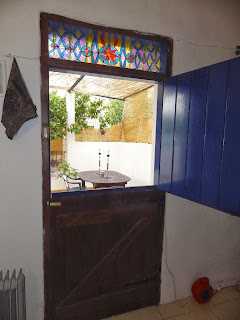
Our cottage is an old farm house complete with stable door and traditional architecture and furnishings but a large modern bathroom and kitchen makes for very comfortable living quarters.  Our landlady, Sally, is lovely to deal with and we have the added bonus of our neighbour Nikos, the gregarious and very friendly taverna owner, just on the other side of our gate.  We have merely to lift the garden gate latch and stroll into his excellent taverna for a late night meal.


The village appears to be quite prosperous with many modern homes dominating the area yet it is dotted with older buildings that point to the way it was. Perivolia is known for it's produce. The village has good water and plenty of it making it  ideal for the orchards. 


Dotted around the village are remains of older buildings fallen down. These make for great pictures and insight into how these were constructed.

Resurrecting older homes in Crete is often not difficult. Once the debris is removed the old walls, being of stone construction, can simply be rebuilt or added to blending old and new in interesting combinations.  In these tough economic times, however, money is always the issue.

This is the path down to our cottage where we pass a newer home on the left and older buildings on the right. The community dogs welcome us loudly each time we pass but they seem to be getting more used to us and thus a little less standoffish and less noisy at our passing. Perhaps some dog treats will help.


 Everywhere the colours of the foliage and plants augment the sites. This is our front gate opening into the courtyard where we spend time writing and relaxing in the warm evenings. The weather here is still in the high 20s all the time and today will be over 30 again so maybe it will be a beach day as we explore the Gramvousa Peninsula on the west coast, about 45 minutes away. The beach at Phalasarna is well known and I am looking forward to exploring it.  At every turn on our daily exploration drives are fascinating churches, often dating back to the 11th century and decorated with exquisite frescoes and mosaics.


Here is something interesting to note. A cut piece of olive wood [above] has been interwoven in this fence and it has grown there surrounding the wire. I'll have to learn more about this wood as it has nothing but its internal resources to grow with.

Someone found this piece of olive wood. It is all one piece and forms the strikingly good outline of the kri kri, the native and increasingly rare wild mountain goat.

We went to Elafonisi on the southwest side of the island one particularly hot day. It is not an easy place to get to as both roads, either the cross country mountain road or the scenic coastal road involve negotiating difficult terrain and breathtakingly tight mountain switchbacks and thus slow travel. When you can peel your eyes from the roads, the views more than compensate for the lengthy journey. Here is the view of the Libyan Sea from a high mountain taverna. 


Elafonisi beach is a pink sand beach with gin clear water and panoramic views of mountain and sea. This picture above right shows the area from the mountain pass while the shore picture tries to capture the alluring pink colour that is subtle but ever present.

Snorkelling one of the reefs I found myself in a large school of barracuda type fish, although these were only about 10 inches long. This school of many hundreds of fish swam in a slow circle around me completely engulfing me in a world of their silvery glow.


Chania remains a favourite place for me. The Old  City, Venetian in origin, is wonderful at anytime, but has a special magic at night. This is the shoulder season so everything is open but without the pressing crowds of summer and also without the oppressive heat of summer that can often exceed 40C. 

Cool evenings and a late supper in a beautiful outdoor setting makes a nice end to another wonderful day on Crete.


Below, the harbour of Chania's Old Town at night


Thursday, October 3, 2013

New and Old, Odds and Sods

This entry to to compile some interesting items that either stand alone or juxtapose past and present. I hope you enjoy some of these pictures and contrasts.


Take for example this shop window in the Bourgo. It features a couple of shelves of papas [Greek Orthodox Priests] engaged in various activities. Some you would expect: baptizing, holding an icon. praying etc. But others are curious. We have the fishing priest or the priest mending nets in the centre front of the top shelf.


What is the market for two priest playing ping pong- or pocket billiards?

Shop windows in the Bourgo are premium space. how does it get given over to these? Just how high is the demand for these images of the priests?


Here a priest doing laundry and a boxer priest. Very different indeed.

In reality the priests seem to be rather aloof. As i walk the streets I often make eye contact with the locals and they are quire friendly while the priests on the other hand seem to look through me or just avoid any eye contact. Strange I think.


This was once a sidewalk or roadside shrine site for commemoration or veneration. Whatever it may have been, the shrine item has been removed and replaced with a public phone in the mountain village of Apeiranthos.

The mountain villages originated when piracy became became a plague several centuries ago. After the fall of the Byzantine [Eastern Roman Empire] beginning around 1000 CE, the pirates [Saracens] made life difficult. Naxos was relatively safe as the population abandoned the coast for the mountain villages in the interior.  The villages were sited first so they could not be seen from the sea and secondly around defensive and agricultural values such as water.


Now this was a really interesting and intriguing scene. On this wind swept ridge high on a mountain pass is an old windmill, the kind that is distinctive of these islands and seen in many places.

Yet right behind is the contemporary wind power generators we see across the world. The old technology and new technology juxtaposed in an eye catching scene.


If you were following my winter blogs you may remember the story of Zeus and Europa . If not you can scroll down and find that entry  from last January on this blog. Here, at the museum  in  Naxos, is a tile floor mosaic of Zeus disguised as a white bull swimming Europa to Crete  after  tricking her.  This mosaic  is especially well preserved and still conveys the brilliant colours
Chalki is another quaint little village and here a family has been making Kitron for five generations. Kitron [ a kind of lemon tasting liquor] is only made on Naxos and thus another feature of the island culture. This distilling kiln was  built by the great great great grandfather of the young woman who gave us the tour. This family business makes only 35,000 bottles a year but it is enough for the family to make a living from their own work, on their own farms and from their distillery. Kitron is a citrus fruit resembling gigantic lemons however it is the leaves of the tree that are used for the distilling of kitron. The peel is used in spoon sweets often used to welcome company to one's home. It is very good. And yes of course we have a bottle. 


Walking along the waterfront I came across this cat in the flowering shrubs- very intent on catching supper. Not sure what creature was there. A bird probably. Cats run wild here and are important for rodent control. Some live a hard life for them. Some islands have an animal rescue league of volunteers composed of ex-pats like the British, and some of the local people. These non-profit groups to try and help these animals with such things as flee collars so they don't suffer as much.

The sheep can be hobbled by some owners so they can't get out the fields and wander around. It is sad to see them restrained in this way and trying to eat the stubble. But again, who wants them grazing in gardens? This is the dry season. Once the rain returns the field spring into green life.


I did not expect to find a tortoise in  the Bourgo 
but here one is. They are rather common
 apparently  but hard to see as they find little 
hideaways during the heat of 
the day and then find their food at night.


Looking through the base of Portara there is an interesting view of the town. This structure has 'watched' the town change and evolve for 26 centuries! Hard to imagine what all has been seen through this space over time- like looking through a portal.

In the Bourgo little unexpected things brighten up an otherwise dull wall such as this decorative feature

A shop in the village of Apeiranthos still features the "old"ways. The mountain villages are known as being a bit a of throw back in time. This is a small grocery store that offeres many home made items. Many of these bottles are various homemade wines, kitron, ouzo and preserves. Fascinating place to shop and the spices are incredible. 
As I mentioned previously, it is very refreshing to shop in 'real' stores where I do not know what I will find, instead of the box stores we are so familiar with and are so predictable. The shop owners and staff add to the enjoyable experience with their helpfulness and wonderful smiles especially when I try to say a few words in Greek- which must sound awful to them. It is also nice to be able to sample each owners wine, olives and spirits - all at very reasonable prices.


Monday, September 30, 2013

The Aegean


Being on an island, even a large island such as Naxos, the sea is never far away and almost always present in some capacity. The people here eat a lot of fish but factory trawlers and overfishing by all nations have managed to destroy much of the wealth of the sea. The red mullet may be disappearing, but octopus is still flourishing on the Aegean's' floor and is a staple here as a snack or a main meal. 

I'm not so fond of calamari. It does look tantalizing to eat doesn't it? How can one resist such beautiful food. Here it is fresh. I watched these dry in the morning sun and then as the chef came to collect it for the evening dinner, I got this picture. These are heavier than they look.

Everyone appreciates the clear waters of the southern climates. These waters are "gin clear" as a friend says. Here the propeller of a rather large fishing boat is clearly seen several feet under the surface against the bottom- perhaps another 20 feet away. When I snorkel it is often hard to judge the relative size of fish because the visibility is so far I can't judge how big they may be against an unknown distant background. In one moment, as I followed a large fish, it was not until I saw discarded tires on the ocean floor that I realized the visibility was in excess of 100 feet and thus the fish was substantial in size.


This is our beach for swimming, Agia Perokopius [Saint Perokopius]. It has lovely sand and a long gentle drop off with gentle rolling waves. Often it is quite still and being just 15 minutes from town by car, quite popular. This is the beach for oldsters like me. Other beaches feature other attractions. Two beaches north is where the wind surfers hang out. Some stretch for miles and some beaches are small and private. Nude bathing is common all over. Yet everywhere someone is anxious to serve me a beer or 1/2 kilo of wine. Nice way to spend a morning.


Never far away is a chapel or church. 
These dot religious reminders dot the landscape and are almost always in 
view if  you take a moment to look.  Many of these churches are used only a few times a year, but all are lovingly tended. 


The ferries are the vital link for the hundreds of islands. Here a regular ferry arrives in port. These are fast moving and the come in with the skill of a race car driver lurching into a turn, spin, stop and quick dock. Imagine the speed that results in this lean on this boat  moments from docking. It probably would not be legal in Canada. Then it is everyone for themselves as those departing- perhaps in the 100's, compete with those boarding, in a rush. Within a very few minutes people, cars, trucks all disembark and embark and the ferry is on its way. Organized chaos!, and fun to watch. In a couple of day we'll be part of departing herd fighting the tide of bodies arriving on Naxos.


This is a cedar park  preserved against the sea where they grow well. It is also a lovely beach for a swim offering many little private areas to read or enjoy the sun


The Palatia (small islet) upon which stands the majestic Portara, is joined to Naxos by a causeway. On either side is a sheltered bay depending on the direction of the wind. To the right is a gentle sandy swimming area and to the left a rocky area that is deeper and lying underneath is the ancient Neolithic village of Naxos.

Every little piece of shoreline offers the beauty of clear warm water and the Aegean greens inviting you for a swim.

Naxos harbour with the island of Paros in the distance. 

This is the village of Apollonus on the far northern tip of the island. It is very secluded and accessible either by boat or long, treacherous narrow switch back roads over the mountain passes. This is a fishing village but it is also home of the Kouros.


The Kouros is an incredible unfinished statue  lying in situ where it was abandoned over 2500 years ago. It is believed to be a statue of Dyonisius or Apollo. No one knows. This is a great example of how the largest marbles were carved into replicas of the gods. The block was chiselled out of the surrounding rock and worked on. When brought near to completion we think it was moved carefully and transported to its final site for finishing.

Something happened here to cause this one to be abandoned. A fault may have been found, or a crack may have emerged. We do not know.

What is very apparent is the size of this carving. If it had been completed in would have weighed about 130 tons and would have been the largest statue of a god in the ancient world. Naxos is well know for its marble and the Naxonian marbles were and are still highly valued.

Here you can appreciate the scale when measured against our friend Evie.


But this is what most think of when we think of the Aegean.
Beautiful gin clear water
And it is everywhere!


Blog Resumed, Sept 2013, Naxos


Being back in Greece it is time to resume the blog of my exploration of the Greek world. This time we are on the beautiful island of Naxos, the largest of the Cyclades Islands.


This is the view of the Aegean from our bedroom window at the Studios Adriani. 

It is like living in a travel brochure. The ocean breezes and swoosh of the waves wake us each morning. Breakfast on the balcony in the shade is a daily treat. Amazing sunsets, refreshing breezes, 80 degree ocean water, its perfect! Our landlady often brings small gifts of food, maybe a melon from her family farm in her mountain village, maybe a sweet honey pound cake from her kitchen - or a dish of hot moussaka straight from her oven. Always a delightful surprise! She speaks no English but wears a gigantic smile. Greek hospitality is awesome!


The Cyclades are a grouping of islands in the central Aegean that appear to loosely be arranged in a circle.

Naxos, the largest of the Cyclades, is home to the ancient gods Apollo and Dionysius. Naxos is an agricultural island and, when necessary in times past, could exist independent from all. The mountain villages still preserve some of the ancient ways while the coastal communities are more modern.

Dionysius was the god of the grape and this island certainly features delicious wine. Did wine originate here? Why not accredit to this place. It had to have originated somewhere!


These islands have been occupied since the late neolithic- or circa 5000 BCE, and became the home of a rich culture notable especially for their simple, distinctive and compellingly profound art. 

These people remain a mystery. The keystone place they occupied in the  origins of Greek mythology is obvious, as Apollo originates from here, but they are obscured from view by time as they pre-dated writing. 

Are these images of Gods? Are they worshippers? Are they the dead? Almost all are undoubtedly female- so, are they fertility cult figures?

Note the figure in the bottom left- it depicts a pregnant female.


Our studio apartment is on the edge of Naxos Town 
in the Grotta and overlooks the Portara- about 500 meters away.

The island in the distance is Paros. In 376 BCE the renewed Athenian navy defeated the Sparta navy. The battle of Naxos was one of the great naval battles of the ancient world. 40 years later the Cyclades came under the rule of Alexander the Great [333 BCE].


The Portara is an iconic marker for Naxos standing on an outcrop of land just above where the neolithic village had been located. This feature is the result of an unfinished temple to the Delian Apollo from the 6th century BCE and is quite unusual as it is not constructed on the normal common east west axis, but rather faces Delos, the most sacred of the Cyclades islands, to the north.

Why did construction stop? Was there a patron who died or ran out money? Did something political happen? Another mystery.

Apollo is one of the more complex of the Olympian gods associated with the sun, light, truth, prophecy, healing, music, poetry and more.  

In Roman times he would be associated with the emperor and thus many of the attributes rubbed off unto Jesus as the debate raged over who was the real Son of God. Much of it begins with Apollo


I snorkelled around the whole of this site the other day and was mesmerized by the thousands of colourful fish, the ancient Neolithic roads and foundations as well as the remains of a Bronze Age village, the remains of both are now below the water's surface since the cataclysmic volcanic explosion of Santorini, circa 1600 BCE, dropped the whole of the Aegean islands several meters further into the sea. Naxos itself was tilted 5 degrees. It's a force we can hardly imagine yet witnessed from a distance when the Christmas Tsunami wrecked havoc in South East Asia


So these are our digs for the first part of our trip. We are in the Grotto - the most ancient part of the town - named for the caves on the sea cliff.

I am also blessed with two lovely travelling companions, one an archaeologist and the other a professor of anthropology.

Life is good!
It is a short walk into the town and the Bourgo [the labyrinth] that leads up to the Kastro [Venetian castle] that dates from 1207, just 4 years after the end of the last [4th] Crusade. Above is a view of the busy harbour taken from the Kastro. Note the Church of Mirtidiotissa on the tiny island. I have no idea how one gets there other then by boat- none of which appear to be available for this purpose. One of the regular high speed ferries is arriving from another island. These ferries ranging from high speed, to fast to regular speed, arrive continually throughout the day linking the intricate life and economies of the islands. 


The Bourgo - an ancient  Greek area- was designed as a labyrinth of streets, allies, stairs; all for defensive purposes. Tiny spaces allowed for easier defence and the intertwining allies gave the defenders advantage over the confused attackers who would be disoriented.

In several places these walkways are hardly wide enough for two people to pass. However, regardless of where one is- it is almost impossible to take a bad picture.

If you wish simply click on a picture and it should enlarge.


Today the pathways offer ever changing vistas and quaint secluded cafes, tavernas, restaurants, homes and shops. 


Shopping is superb, vendors are friendly and informative. With many jewellers, artists, potters, glass blowers and clothing stores featuring their wears at every turn, nick and corner everyone finds something of interest. It is refreshing to go to a shopping area that does not offer more of the same, as we commonly experience in our cities. Here the small entrepreneur is still the most common business person. 


At many places, the houses above span the lanes so when we walk under a tunnel there may be a living room or bedroom above. When one buys a 'house' here you buy a part of a structure but not he land. Imagine the kinds of paperwork that requires! - but such is Naxos!


The Bourgo is mostly from the Greek period while the upper Kastro is located on the acropolis and dates from the Venetian rule. 

Naxos was the seat of power for Venetian Rule of the Aegean for many centuries and the Kastro was the home of the Venetian ruler- usually called the ambassador. 


 Below is the main entrance to the Kastro. The door is original dating from 1207. Lower class people who wanted to visit the ruling family would sit and wait amongst the guards in this space, sometimes for days, in hope of being granted an audience. Imagine coming day after day for many days and simply waiting for an opportunity to deliver your message or make your "Ask".


Below is the dungeon of the Kastro now converted into an art gallery. You can still see the timbers from which prisoners would be hung in nets, or by their arms, or in tight iron cages. The small black door on the bottom centre of the far wall opens into a "pit" where serious prisoners where shut in for 40 days. If after 40 days they were alive and disease free they were deemed innocent and realized. One can only imagine the horrors and terrors of this space. 


The Bourgo is dotted with lovely gardens such as this bougainvillaea overhanging the wall and stairway.

This shop has 5 ancient pillars [Ionic columns] relocated [ or re-purposed] from other places around the island. Stones and marbles from temples and other buildings are often salvaged and relocated. These stones are commonly seen in door ways and gates.


Such is Naxos, a jewel of an island in the middle of the Aegean Sea.
It is a wonderful place to visit and study!