Showing posts with label naval warfare. Show all posts

Monday, October 14, 2013

A Cretan Tale of Intrigue, Courage and Defiance

Perhaps you have seen the 1950 movie “Ill Met by Moonlight”, starring Dirk Bogart.

It is a true story of an incredible adventure that took place in Crete.

It’s a story of tenacity and courage that sparks the imagination and has all the features of daring, luck, skill, humour, horror and more. If it weren't for the fact that it is true, it would been branded unbelievable fiction.

This picture [above] shows a WW2 German anti-aircraft gun abandoned beside an old olive tree on a hillside in Therisio.  Such sites are not common on Crete - but the evidence of the war is still there when you pay attention to detail.

The Nazis occupation of Crete in May 1941 was undertaken to complete their zone of security on their southern flank before attacking Russia. The occupation, like most all the land taken by the Nazis, was brutal. The Cretans refused to surrender their freedom to Nazi enslavement. Several soldiers left behind after the British evacuation, following their defeat in the Battle for Crete, augmented the Cretan freedom fighters and gave the German occupation force a difficult time.


Above is a WW2 German anti-aircraft fortified emplacement overlooking Souda Bay at Aptera, a military site in almost continuous military use for the last 3000 years beginning with the Mycenaeans. Here stones from 2000 year old Roman homes are used to protect this WW2 anti-aricraft installation.

Resistance to Nazi occupation was strong on Crete. Either side showed little mercy. The Cretan resistance fighters wanted to make a big symbolic splash and hatched a wild idea. The British Special Operations Executive [SOE] refined the plan in 1943 to capture commanding General Muller, one of the more nasty of the Nazi generals of the Third Reich and commander of all German forces on Crete.


However, before all the details could be completed for the SOE plan to be put into action in 1944, General Kreipe [above] had replaced the primary target, Muller. Maj Patrick Fermor, a travel writer before the war who was, in 1943, of the SOE known as ‘Paddy’, masterminded the plan in conjunction with the Cretan Resistance fighters.

Can it get more British than this? His associate was Capt. Stanley Moss, a carefree sort of personality with overflowing confidence.

The two Brits were smuggled into Crete and given support and protection by the Cretan people and freedom fighters, especially the Andartes Guerrillas group from the south mountain coast. They recruited the team for the Kreipe Caper.


On the evening of April 26, 1944, General Kreipe was travelling to his residence, the Villa Ariadne in Knossos.

This detail adds to the story bringing in Greek Mythology and the ancient Minoans, as this villa was the original residence of Arthur Evans, the great archaeologist who explored the Minoan Civilization and brought it to light. Ariadne, the legendary daughter of the Minoan king Minos, helped Theseus kill the Minotaur in the Labyrinth and escape to Naxos where he abandoned her to become the wife of Dionysius, the god of wine.

Read between the lines and both these stories are about oppression, courage, justice and freedom and a bold plan.

So on April 26 Kriepe and his driver are stopped on the road home by Moss, Fermor and the guerillas dressed in German uniforms. Kriepe is handcuffed and bundled into the trunk.

Fermor assumed Kreipe’s identify with Moss as the driver and off they go, brazenly bluffing their way through 22 German roadblocks and eventually disappearing into the relative safety of the mountains.

This is Kreipe's Mercedes on display in the War Museum. Needless to say, this kidnapping of a prominent general represented an incredible threat (not to mention insult) to the Germans on many levels.


Here are Moss, Paddy and General Kreipe in the mountains. Kreipe was not the worst kind of Nazi General although he did serve in the Russian Campaign. He tried to reverse the cruelties of his extreme predecessor and bring some balance to the German occupation of Crete. He had acquired a relative level of respect- but he remained an unwelcome leader of the occupation.


The bold kidnapping and subsequent embarrassment of the German army resulted in an 18 day adventure as 1000’s of soldiers were assigned to the rescue. The Andartes Guerillas led this band over the roughest mountains of Crete, including Mount Ida, the mythical home of Zeus, living in caves, avoiding capture and, 18 days later, securing rescue by submarine on the south coast near Rodakino. Literally hundreds of Cretans had become aware of exactly what had happened, where the kidnappers were as they moved slowly from village to village, with partisan scouts preparing the way, yet not one whispered a word.
After escape by submarine they went to Cairo. This is a picture above, I took on a slope of Mt Ida last winter. The incredible challenge of this terrain is hard to capture on a picture.

But for the Cretans there was no rescue. Reprisal was horrible by the enraged Germans. The village of Anogia on the slopes of Mount Ida was completely destroyed for helping the caper heroes. Many other villages suffered reprisals as the Germans rounded up people from many villages, men women and children, and executed them. Yet it is noted the Cretans felt several centimetres taller and were filled with pride having visited such an embarrassment on their Nazi persecutors. 


Who could have imagined a better story? All the ingredients of history, mythology, resistance, courage, tragedy and hope combine in this story too large to believe, but incredible stories are just that. 


The Battle for Crete and the subsequent occupation is not a story we are familiar with in the west. We know more about resistance and oppression in France and the Low Countries. Yet this Aegean war story, in this corner of the world, has its own incredible story worthy of awareness.

To the right is a bombed building from the German invasion of Crete still preserved as it appeared in Chania, as a reminder of the arial bombing that preceded the airborne invasion.

Greece tried to remain out of the war as a neutral but the Italians invaded through the Balkans in 1940. They were inept and were defeated by the small Greek army. The British then sent 60,000 troops to reinforce Greece and its strategic value. In 1941 the Nazis were preparing to invade Russia but saw the Aegean as a liability if not secured from the British first.


By May 1941 only Crete remained in British hands and they fought fiercely to keep it.

German intelligence was intercepted through the British ability to read the “Ultra Code” so surprise was compromised and the Australian, New Zealand, British soldiers were waiting in the German drop zones as the first large parachute and glider invasion of history took place in Maleme. The first two days were a slaughter of young German soldiers.

The sea and air battles were fierce [5 Canadian pilots died in the air]. The British lost 9 ships sunk and 18 damaged. The Germans lost 370 aircraft shot down.


The terrible cost of men and equipment was too high for the British to sustain this early in the war. Crete had to be abandoned and the defense moved to Egypt. A fighting retreat took place through the White Mountains, which are ever in our view here in Western Crete each day. 5000 soldiers were assigned to covering the retreat and for who rescue would not come. After the battle they dispersed to augment Cretan resistance fighters across Crete.

The Germans lost over 4000 men. 
The British, New Zealand and Australians over 2000 with 17,000 captured. 

Nevertheless, the main body of this small army escaped by sea. Hill 107 [right] at Melame was the first objective for the first day of the invasion for the German airborne troops as it had a commanding view of the Maleme airfield, through which all the follow support came. 

Today, on this hill, over 4000 German young men lie in their graves [above right]. Thirty kilometers [left] away, the Allied dead are buried. 


The local villagers, as the first weeks of battle raged, buried the soldiers of both sides. However after the withdrawal of the British, the Germans relocated the Allied dead to another grave field and paid little attention to preserving identities. After the war these remains were disinterred yet again and moved to the current location at Souda Bay. As a result less than half are known by other than their national uniform.

Here on the right are German artifacts left from the battle for Melame in the war museum in Chania.

The Second World War did not really end ‘war’ for Greece as it did for the rest of Europe. There were issues of revenge and retribution against Germans as well as the Cretan collaborators. 

Below is a Cretan wedding dress made from German parachute silks and cords.

After the war the civil unrest continued. The Greek civil war went on from 1946-1949. In 1967 ,“Time of the Generals", another disturbance resulted in the rule of the Junta. All these events took its toll on Crete as young men were inducted into the army to fight the mainland's battles. It was not good and peace did not come to Greece until 1974 when a student uprising in Athens famously threw out the generals and the Greeks began to enjoy a true democracy. 

 In the 1960’s mass tourism began in Crete bringing with it tremendous change. At the same time Crete embraced industrial agriculture and became a great economic success story, but overuse of fertilizers have brought environmental concern here, like everywhere else. 

Economic changes have resulted in some villages being abandoned and the major centers have grown, with Herakleon becoming one of the largest cities in Greece with over a million people. At the time of the Kreipe kidnapping Heraklion was only 35,000 residents. 

The shepherds are a disappearing breed, but the sheep and goats are growing in numbers and sprawling across the mountain sides. Change here, like everywhere, follows its own path with environmental and cultural debates about what it best. 

While on my way between the islands of Paros and Delos we passed through this formation of Greek naval vessels on manoeuvres. It is an ever present reminder that peace in this part of the world is still tenuous and never taken for granted.

Even as I write these words on Thanksgiving Monday morning the Greek Airforce is up a practicing over the city and mountains. When tensions rise in this part of the world Souda Bay still becomes a very busy place.

Wednesday, January 23, 2013

Now For Something Completely Different, The Dreadnaught Averof


I have long had a great interest in naval history and one of my hopes of this trip was to make it to the Greek Naval Museum in Paliofaliro.

The main attraction there is the Averof

The Battleship Averof [really a heavy cruiser] is the last 'dreadnought' heavy cruiser of its kind in the world.


The first dreadnought [a category of ship named after the first of its kind HMS Dreadnought] was built in 1906 and marked a change in naval architecture.

The Averof was built in 1910 and thus features the early form modern battleships took.


Through the years the great battleships, with ever bigger armament , ever thicker armour and faster speeds, were the masters of the oceans.

This evolution would culminate in the great battleships of early WW2 when the world learned how vulnerable these ships were to air attack.


The Averof has a history of humour and distinction.

For many years it was it was the greatest weapon platform in the Aegean.


It almost single handed won two great naval confrontations against the Turks in the First Balkan War [1912-13] .

This gave the Greeks uncontested control of the Aegean following the First World War until 1941, and this ship was the reason.


It's main armament were 4 - 9.2 inch guns that could hurl a 1000 pound shell accurately over 20 miles.


This is the exterior of the magazines where the shells and propellants were stored. On the black rails, hanging from the ceiling, the munitions were run to elevators that lifted the explosives to the turrets, three decks above.

I could barely stand up in this space and had to take care not to whack my head. That door was a real challenge to get through. The further into the ship I went the more claustrophobic I became. Unbelievable that men could function here.


After surviving the Battle for Greece and the Battle for Crete [1941] the Averof served as an escort ship for convoys in the Indian Ocean.


It remains in active service today. It is assigned to 'long term repairs' at its birth where it is a proud symbol of Greek naval ability where it also serves as a museum.


On the humorous side of this ship's history is the story of when it sailed to England for the coronation of King George V. The Greek crew was served blue cheese. They had never seen such food. They rioted- causing a near mutiny. I might rebel as well- I do not care for rotten cheese either!

This is the crew's mess. Note the bags hooked on the wall- these are their kits where each stored his entire personal belongings.


These are the officer's dinner service.

Doesn't compare very well does it?

Such was turn of the century life. Remember the Titanic where the difference between first class and third class represented world's apart.


This is how the crew's beds are arranged for sleeping.

Note the table and benches have been attached to the ceiling.

This is how it was at the turn of the century- the 'old world' separation of officer and sailor was a gulf across which few ever crossed.


Recently a wealthy Greek shipping tycoon and actress used the ship for a wedding reception, without permission, causing a scandal.

Some things never change!

This is the officers mess-

no beds in sight here-

they each had their own room!


A senior officer's  room


An officer's 'head'


The captains's quarters. This space appears to match the space of all the others combined!

This was part of the disaster of WW1-

old habits, old ways, entitlement, and family hierarchy against a new world of mechanized killing that 19th century outdated values simply had not adapted to.

As a result- millions died.

The Averof represents a living example of the past rarely experienced anymore. Most all of these great ships have been destroyed in war or laid to scrap long ago.


Friday, January 11, 2013

Naval Museum Chania

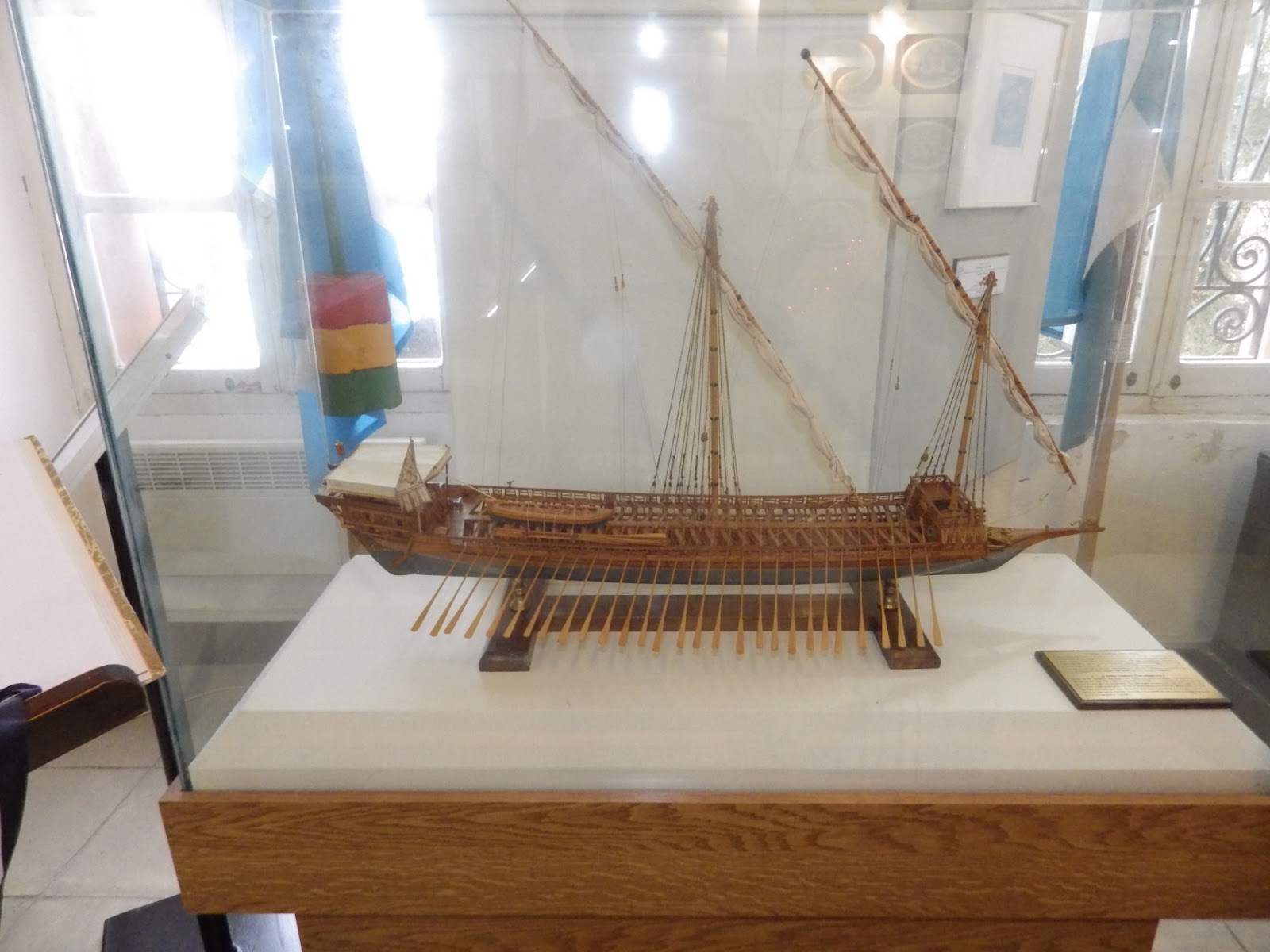
The Chania Naval Museum is a collection of scale models wonderfully crafted. While I was there I found my way into the back workshop where two men were making yet another model from scratch. 


Human beings are known to have been building boats since the Metholithic [middle stone age] Period, about 13,000 years ago.

Circa 6000 BCE we begin to see advanced ships capable of real sea travel, the exercise of power and trade.

This is an example of one such design. Note the fish on the bow.


This is what an early Minoan trading ship is believed to have looked like.

Little archaeological evidence has been found of these early ships dating back 5000 years or more.

Much is conjecture from the evidence that does exist


The cutaway views are what really help us understand the nature and structure of these vessels.

Note the cargo hold and how large the capacity of these ships may have been. 

The Minoans pioneered real ship design and built the first sophisticated ships in the world.

China was also building great seafaring ships about the same time. Was there communication or a sharing of technology in the distant past? Recent evidence is suggesting windows of trade and travel opened and closed at various times in the distant past, especially in the bronze age when the Minoans reached their peak.


The advances in technology over a 1500 years are evident.

The use of human power [slaves?] speaks to the evolution of civilization.

This would have been a combat vessel with the early ram intended to 'spear' an opponent and provide a ramp for soldiers to board supported by others on the raised rampart.


This is a Greek warship that would have been built in the time of the Athenian Empire [500 BCE] which controlled the Aegean Sea and exercised power as far away as Italy.

It was these ships that held the Persian Empire at bay until Alexander the Great [300 BCE] invaded and destroyed them as a political power.


As an aside, the Jewish people of the Persian Empire gladly supported Persian rule as Persia protected their relative freedom, especially in terms of freedom of faith.

It was Cyrus who allowed the Jewish Exiles to return home in the year 539 BCE and rebuild the temple. This is when Judaism as we know it began


This is a Roman Trieme -so named because of its three banks of rowers. It was the Carthaginians that appear to have master the naval fighting ship and the Romans adopted their superior design.

It is estimated these ships could get up to 20 knots of ramming speed, for a brief time and under the right conditions.

These are the ships Augustus, Anthony and Cleopatra used at the decisive battle of Achtion that ended the Roman Civil War and began the Republic a couple of decades before Jesus was born.


This is the design of a Venetian ship circa 1200 CE. 

Can you imagine to work and patience that goes into building one of these models.

All the pieces are fashioned from scratch by these talented modelers.

The quality of the work is wonderful. Hundreds of hours go into each model.


 If I understood the one man who spoke some English in the workshop of the Museum, there are seven of them on the team who work away on various projects, some collectively and some independently.


The Museum features 6000 years of naval architecture researched from many sources and archaeological evidence.


Chania was a Venetian Port City beginning about 1200 CE.

This large model [about 8'X8'] shows how the city looked at that time.

Many of the old structures presented earlier in this blog can be located on this model.


The Museum also features more recent history.

This frigate represents some to the incredible quality of the ships as human beings approached the end of the age of sail.

If you have never visited a tall ship, it is well worth the visit to appreciate the technology of these vessels and the skill of teamwork required to work one.


At the turn of the 19th century the first sophisticated steel ships were being made into weapons platforms.

This is an example of one of these early 20th century ships


By the time of WW2, 40 years later, human beings had mastered the skill of killing one another at sea.

This is a six foot long model of a US battleship.

These capital ships came at the end of the age of battleships, as air power during WW2 revealed their vulnerability to air attack. 


The Museum has walk in displays such as this replica bridge structure of a small WW2 destroyer


There is little here designed for comfort!


These are the mechanical parts of a German WW2 torpedo.

Again we are reminded that 80% of all the research that goes on in the world is first of a military nature.

Imagine if we could find the will to turn that number on its head and use 80% of our energy for the greater human good?


When I get to Athens next week I'm planning on visiting the naval museum in Pireaus.

On that site is the only surviving real dreadnaught in the world. These great WW1 battleships changed naval warfare.

However, if you are ever in Chania- this museum will be well worth the visit as this is just a taste of what it offers.  It is wonderfully laid out, well explained in English as well as Greek, and the old building itself is a treat with its arches, old windows and great architecture.