
When you visit Crete, olives are going to be ever present. Whether it is drizzled over a salad, pooled on a plate to dip warm fresh bread, soap for your bath, creams for your skin, in a pan to roast your lamb, or presented as an appetizer with a drink in a bar.... olives are everywhere.
Here an orange grove is sandwiched between two olive orchards

The trees are everywhere; the pruned wood from the trees fire the wood stoves in the winter houses and outdoor cooking grills.
When I pause to look at the detail of a view - it is rare not to see hundreds of olive trees.

The lush greens of the fields are especially contrasted against the silvery grey-green of the olive leaves

The undergrowth are fields of flowers - especially lovely.
One of flowers common all over the island are huge geraniums, but at this time of the year, we also see wild mustard, lantana shrubs, morning glories, bits of bougainvillea hanging on from summer, roses, and other wild flowers. In a month or so, the delicate wild poppies will cover the fields, with marguerite daisies and tiny wild orchids and heathers.

This is the olive orchard just outside my door. For the past few weeks, the neighbours have been busy harvesting the olives, pruning the trees and burning the slash. The forest fire index here is so critical, this is the only time of year they can have open fires.

It is so tempting on a walk to reach up a pluck an olive, but I was surprised by how truly awful a ripe olive tastes! It is bitter. The olives are soaked in a salt brine which is changed every 4 days or so for at least a month, until they begin to taste they way you want them.
Everyone has their own particular way which adds to a variety of tastes. Some are brined, some soaked in oil, some are rolled in sea salt for example.
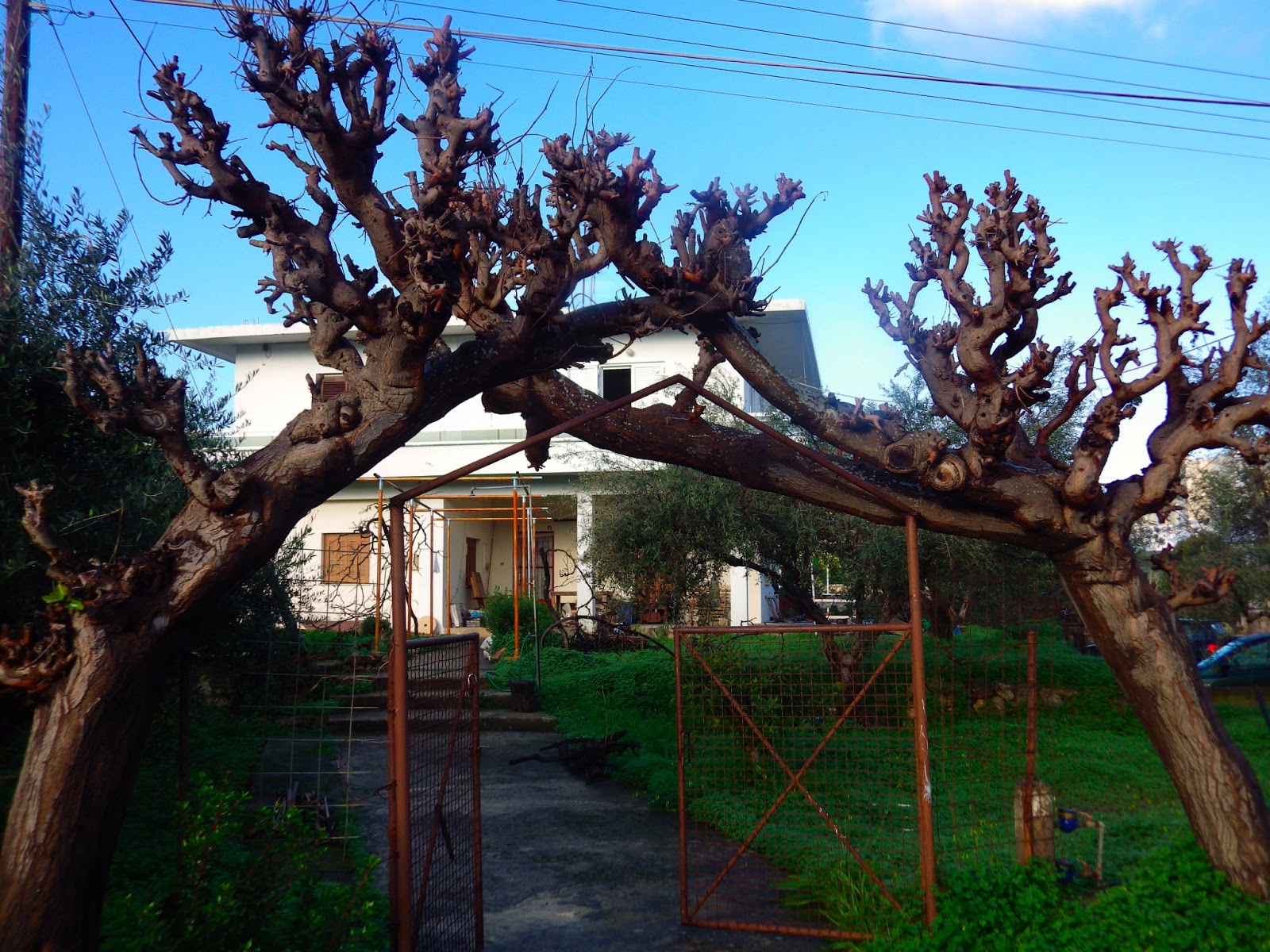
The pruning is severe in gardens. There are continuous piles of olive branches burning somewhere - and they smell quite nice- adding another dynamic to this place. Yes, these will sprout new growth this year!


Olives and their oil are a part of almost every meal.
It is estimated in one of the Crete travel guides I have, that there are 5,000,000 olive trees on this island.
The sites and sounds of harvest have surrounded me everyday as I travel. The harvest goes on for several months and is apparently approaching its end.
Men raking the trees with powered mop-like brushes to drop the olives onto mesh nets under the trees.

Olive trees can live a very long time- some are estimated to be more than 2000 years old.
Imagine, one tree planted when Jesus walked this earth still producing olive today!
This one I saw in Gortys is over a 1000 years old.


When they die they are used as fire wood mostly - but several appear as decoration because of the unusual way they age- such as this 'skeleton' of a dead trunk set against a garden wall.
Some of the wood is also used for fine woodworking and carving - bowls, kitchen utensils, chess boards, religious icons, crosses and more.

On my visit to Phaistos, a Minoan Palace site over looking the Mesara Plane, olive trees dominated the view.
100,000s of trees!
And I love eating olives!!!


