
Perhaps you share an interest of mine- the door.
Take this door for example. It is obviously quite old and is found in a very aged building. You or I might see it as dilapidated, or perhaps we see it as 'beautiful' in a way only years bring about. The shiny new red bicycle adds contrast to the drab weathered features of the wall and door.
The passage of years is embodied in this door. It bears the 'scars' of time. Note as well the current frame appears to be set in a larger and older opening.
We may take doors for granted much of the time but inevitably, in every life, arrives the time when a door in our lives is powerful, symbolic often marking a transition. Perhaps the end of a job. Graduation. A new home. A new living partner. A nursing home. Doors open; doors close.

Doors are important- and interesting.
 As you read these words or glance at these pictures consider the passages of your life, when important or powerful doors have opened or closed.
Recall some of those moments when you have arrived at 'your' door or transition, real or metaphoric, opened it, and step across its threshold into a future, or closed it and walked away from a chapter in your life.

This blog entry is a photo essay on doors, thresholds and passages that I have encountered during my walkabouts in the towns and villages of the islands of the Aegean.
I hope you enjoy looking at the photos and reflecting on doors. (Click on any photo to enlarge.)

Right, is a beautiful door that conveys strength and a well kept - probably tiny, home. Pride of ownership is evident.
 Contrasted with this door on the left: a door that invites renovation and restoration.
How old is it?
What all has happened while this door has hung here?
Who has passed through it?
What's on the other side?

Some doors are forbidding, some are inviting, some are ancient, some are curious.

A few of these photos have appeared in previous blog entries but most are new pictures from Crete and the Cyclades.
Should you find this picture essay of interest, drop me a comment on what thoughts this has brought to mind, or what memories of doors or doorways this might have triggered, real or metamorphic, or perhaps you have your own door story. Please share.
Do you have a doorway "saying" that lingers in your self-talk - perhaps one that is important to you?

For me, it is the terrible [again I stress "for me"] religious saying: "God never closes a door without opening another."
It bothers me in that it does two things in my mind and both can be harmful. First, it makes God responsible for all the misfortunate that visits us in life - a belief I find appalling. Secondly, when a person is diminished by a life event, this truism suggests they are somehow at fault for not finding or grasping the opportunity that God also provided.

Right is the Portara of Naxos, a doorway to the temple to the Delian Apollo that was abandoned for unknown reasons.... war, attack, lack of funds, lack of interest - who knows. We assume it was abandoned because the construction features that would have been removed are still present on the gigantic blocks that make the door. This doorway has stood for almost 3000 years! Neither earthquake nor war has brought it down and no one chose to relocate its incredible marble. What I find curious, is that they started construction by laying out the perimeter foundations and erected the door. As a builder myself, it seems to me the doors and windows come after you erect the walls. Curious.
Today it stands as a portal of time and a calm, giant guardian symbol of the island.

Janus - God of openings and doorways - new beginnings and endings, was the Roman God of the threshold and he continues to be acknowledged in our New Year's festivities today.
Many people have door rituals. Most of us give ourselves a last quick check in front of the hall mirror before crossing the threshold!
The Greek Orthodox will mark their doorways with a cross, made from the candle they have carefully brought home from midnight Easter mass. This precious flame is first lit in Jerusalem and then travels the world by plane to all Greek Orthodox communities. On Easter eve, it is lit in the church, then passed on by the priests and worshippers to be shared, symbolizing the light and hope of the Resurrection.
The Jewish have their Mezuzah to fulfill the commandment of putting the words of Torah on your gates so you may contemplate them upon leaving and entering your home. Inside the mezuzah is a piece of parchment that contains verses from the Torah.
The Chinese have many important requirements about the construction of doors. For example a front door and a back door should never line up, as the good fortune that may enter a home may simply pass through and out the other door. Offsetting doors makes it possible for good luck to remain.
Doors were invented for privacy, protection and to control the impact of weather.

This door [right] - appearing to be quite old, slides across the entrance to this upper floor home. Was that for weather or protection or practical reasons - perhaps the want of a good set of hinges?
 The first doors we know about in history are painted on the walls of the Old Kingdom Egyptian tombs.
 These appear to depict simple single slab doors. Given the exceptional dry climate of Egypt a single slab would not be subject to much warping.
This picture [left] is of the first true door we know about and it comes from Switzerland and through carbon dating is thought to be about 5000 years old.

Many of us pay attention in a particular way to the doors of our homes.
Security and privacy are certainly of immediate concern but the other aspects quickly gain our attention.
 Colour, construct, design, window treatment, hardware and more enter the conversation with those who share an interest in "our door."
Some of us pay a great deal of money for our door. We may hang wreaths, a family name or crest, a greeting or decoration to the door.
Above right an old arched doorway on Naxos has been rather crudely filled in, making for an interesting incongruence in an old stone wall. The street has been moved a few feet over. Huumm?

This plant grows in front of the electric power meter of this closed cafe.
Notice how the wall stucco has been simply applied over the otherwise rough- undoubtedly stone, wall found on Mykonos.
Each island of the Cyclades has its own distinctive variations that allow a person to easily deduce which island it is if the detail is present. Some actually have by-laws now that protect the "Cycladic" look to any new architectural projects.
 There are the unusual and surprising doors.
What has happened here? Is it a door or a window? In the restoration of this building the workers came across this old, oddly filled in space that appears to me to be a doorway. Regardless they made a decision to preserve it as a piece of street scape in an otherwise bland wall.
 Or consider this door below right, at the top of a stairway, with the hatch immediately above. How was it used? Was this a defensive feature to fire down at an enemy or is it a functional feature? For what? Ventilation possibly.
Or look closely at this intentional oversight in a renovation below left. A door has as been left hanging in the air! Was this laziness? Intentional? Humorous? Yet here it is a doorway from no where and to no where but was once from some where?

 This ancient Roman doorway in the village of Argyroupoli is now the gate to a private home. The inscription over it reads "All is smoke and shadow." Is that a cynical belief or an astute observation? What circumstance might have given rise to such a quote? We know that this village was destroyed during the Octavian - Anthony phase of the civil war in the 40's BCE when Anthony ordered it destroyed because the villagers supported Octavian.
 Below left is a little door in the wall of a house that reminds me of the old coal chutes. It is about 3 ft high now. Maybe there is more of it below the current street level? It is old and now filled in. What was it for?
The door below right has been seen before in this blog. It is the original door set in this archway of the Kastro in 1204- just after the last crusade ended! How many have passed through this door. This is part of visiting this part of the world with such history and the evidence of life past.

Some more doors that are just pretty


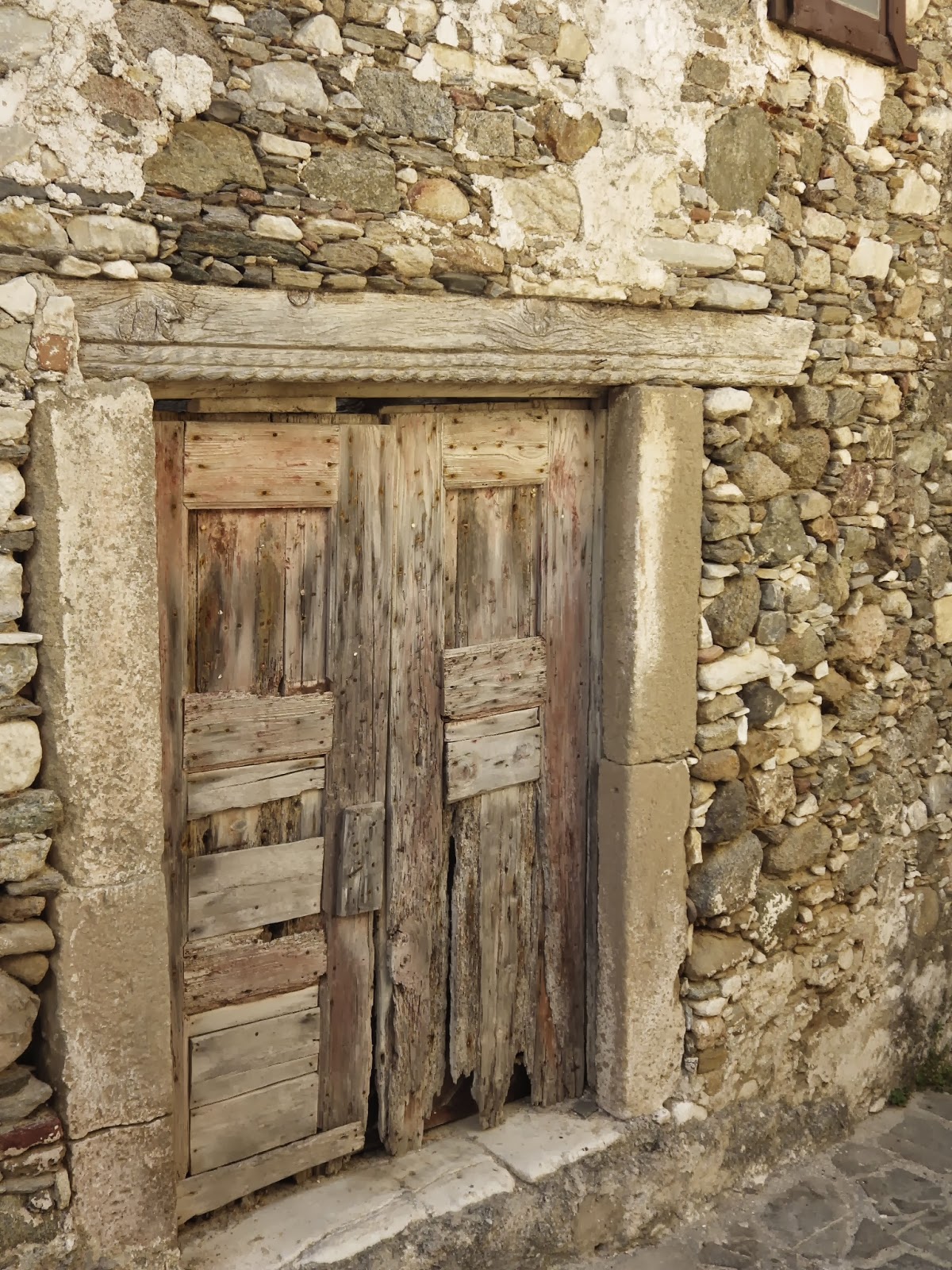
 This is one of the more intriguing doors I have found. That it is old is obvious. In need of serious repair - yes. And it is the entry to one of the outdoor music venues of Naxos in the Kastro. This court yard overlooks the Aegean on one side and surrounded on ancient stone on three sides. Coloured lights hang in the trees. It must be enchanting to see a performance here. Oh yah - it only seats maybe 25 at the most!
Another elegant doorway.
Note the family shield.
Below is a giant of a door in the Fortezza in the lovely city of Rethymnon on Crete. It was the main entrance to the fortifications. Notice the man-door set into the left hand door. This gives perspective on its size.

This is the doorway of a church over a 1000 years old on Crete. How many foot steps of the devout does it take to wear the tread like this ?

Lastly- these are two of our doorways in our long term rental property on Crete in Perivolia.
First, our back gate opens directly into the taverna next door with its wonderful, authentic Cretan food prepared by the affable Greek host Nikos, and secondly our living room door - a split stable door - that opens to our courtyard, a place of peace and sanctuary where I sit now writing these words.


There are things known and things unknown... and in between are the doors.
Jim Morrison, (The Doors)


